My first two choices for EDC (Every Day Carry) knives are:
1. GENUINE Swiss Army knife (don't bother with imitations they are all junk with red handles). The most used "blades" on my Swiss Army knives are the toothpick, tweezers and scissors, but I once sawed through a 2X4 with the saw of one of my Swiss Army knives.
2. GENUINE Leatherman Multi-tool (again don't bother with cheap imitations) One of my GENUINE Swiss Army knives has a tiny pair of pliers that might come in handy if working on something really small. For real gripping ability I go with one of my Leatherman Multi-tools with either regular or needle nose pliers.
I can't imagine going into the wilderness without those two tools and I wouldn't want to spend many days in the burbs without them either.
"But Dave," I hear you say, "for WTSHTF or TEOTWAWKI we're gunn'a need a BIG knife." Well yes you will, which is why I own a genuine Randall model #14 with a seven and a half inch blade. It's not for nothing the Mountain Men carried large knives and hatchets as well as smaller knives for skinning and camp chores. The question you have to ask yourself is just what do you expect to be doing with that big knife?
If your survival retreat is anywhere near civilization you'll probably find a GENUINE Swiss Army knife & Leatherman Multi-tool to be the most used ever day carry tool. On the other hand if you plan to be dressing out elk and moose…
GENUINE Swiss Army knives & Leatherman Multi-tools are both "generalist" tools doing many things but not optimized for any one specialized task.
With larger knives you necessarily have to get more specialized. Do you want a hunting knife, a Combat knife, a Survival knife, a Fishing knife or a Skinning knife? All of the aforementioned will do just about anything any of the others will do, but some will perform certain tasks faster or easier (i.e. better) than others.
First you figure out just what it is you want to do with the big knife then you pick a knife that does that.
A quality Bowie knife will kill men and bears, chop down small trees* and impress the heck out of passersby. So will an Arkansas toothpick but it's hard to gut/skin a squirrel or clean a trout with either of them.
On the other hand fishing or skinning knives will kill you just as dead as any combat knife but are ill suited for combat. So what to choose?
If you decide one of the military knives will do what you want done try to buy the real thing. A real Ka-Bar or genuine Pilot's survival knife will outlast those cheap imitations.
Ignoring, for the moment, fantasies of swinging on a vine over a crocodile infested pool of quicksand to cut through the wall of the log cabin with your sheath knife and save the damsel in distress, we must ask ourselves "What will I most likely be doing day in and day out that would require a knife?" Then get a knife that'll do that.
Whether it's the burbs or the bunker, I don't leave home without my Genuine Swiss army knife and/or Genuine Leatherman tool.
*Chopping at small trees with large knives used like an ax is one way to cut young trees, but a knife blade doesn't have the weight of an ax head. Placing the cutting edge of the blade against the sapling and then striking the back of the blade with a small wooden club EXACTLY above the point where the cutting edge meets the sapling concentrates the weight of your club at the point of contact. Be sure to strike with the force of your blow pushing straight down through the blade – NOT at an angle to it.
Use a small log about the size of your forearm as a club and use alternating cuts (from above then from below) just as you would with an ax. This technique doesn't work as well with a standard butcher knife because the thin back edge of the blade of a butcher knife can cut into the log almost as well as the sharp side can cut into the tree.
- 0 – 0 – 0 – 0 – 0 – 0-
GWQ comments:
My EDC is a Leatherman Micra. The folding scissors work well and are handy. It also sounds more "normal" to carry folding scissors than a knife. The bottle opener is a good feature, too. It does have some basic tools and a small blade on it. If TSHTF and I need some of the tools on it, it'll be infinitely better than not having any knife even if it's not as comprehensive as some of the ginormous multitools out there. It's a Leatherman so it's good quality and works.
I like that its small enough to fit inside my key chain pouch. I have my housekeys on the keyring that's attached to a small zippered Coach pouch (look for the mini skinny styles).
In there I have my Micra, an expired drivers license (in case I ever get hit by a car walking the dog and don't have any other ID on me), and some emergency cash (usually $20, right now it's only $5 so I need to add some more).
At last! Something to do with old driver's licenses! That's a great idea.
And, yes, scissors may be as handy to have as pliers if the urgent need ever arises.
- 0 – 0 – 0 – 0 – 0 – 0-
SSM comments:
My EDCK is scissors. They cut paper, tape, and string better than a normal knife and will defend you well in a bad situation. That said I have a slew of knives but from a pure utility perspective, scissors do most cutting tasks a lot better than the latest sexy $200 Benchmade autofolder.
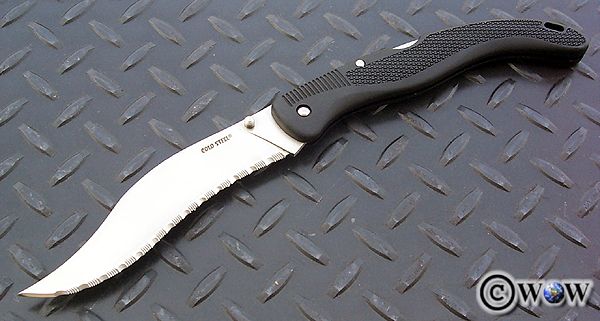
My favorite knife, that said, is the big ol' Cold Steel Vaquero Grande. It will cut down trees about 2" thick in under a minute.
- - - SSM adds:
If you haven't used any Cold Steel products, they're the toughest knives I've ever owned. Shave hair sharp too, out of the box, and after use. Many of their knives use very low carbon, thus very hard and sharp, steels. However, they corrode easier and have to be taken care of.
I have one of their fixed blade Bowie knives too that is about 3/8" thick and is essentially indestructible.
- 0 – 0 – 0 – 0 – 0 – 0-
HCF comments:
My every-day carry is a Leatherman Juice S2. It's small enough to be on a keychain. It has a nice assortment of screwdriver blades, scissors, pliers, and a small knife blade. But my favorite feature is it's BRIGHT SCREAMING ORANGE which makes it hard to lose.
- 0 – 0 – 0 – 0 – 0 – 0-
GH comments:
Mine is simple, it's the minimist Swiss Army knife, [Signature Lite] which has a 1) knife blade and 2) nail file (with flat head screwdriver) on one side, and scissors on the other. The toothpick and tweezers have been replaced with a ballpoint pen and a white LED flashlight which you use by squeezing the handle. About $30, IIRC. The flashlight is surprisingly powerful, considering. I have used it as a signal lamp to get my wife's attention in a large and busy train station, and, obviously, to light the keyhole on the trunk of our van on a dark night. It would certainly be helpful to "flash" a helicopter overhead, should the need arise. I had a previous one for two years without replacing the battery; I did replace the ball point pen once because I used it so much.
This one is even thinner than my last, which was also a Swiss Army knife with 1) knife and 2) can opener (with phillips screwdriver at the top) and on the other side 1) nail file (with flat head screwdriver) and 2) scissors. It also had the ball point pen and LED light, although that one was one of their first models and only came with a red light, which was less useful. I have fairly regular use for the screwdriver(s), but have to be careful not to use the knife handle as the torque mechanism, as they can bend at the hinge if the screw is balky, ruining the knife. There's plenty of "grip" along the knife blade or file blade to accomplish the task.
I find having a ball point with me at all times invaluable, I'm forever having to write down something in the middle of a store, or the name of a CD I found at the "used" store but don't want to buy until I check it out online or something.
Usually there is a toothpick and tweezer nearby, because my wife carries one of the older SAKs [Swiss Army Knives] which has those. The one I have now is the smallest, sleekest yet, and I'd feel lost without it. It's on my keyring always, except going through airports for the obvious reason.
- 0 – 0 – 0 – 0 – 0 – 0-
jC writes:
For years I carried a Buck lock back folding knife in a belt sheath; a strong, easily sharpened useful tool with a legal length. Too many people objected to it as a lethal weapon, so I went to a 3 bladed whittler, probable the most versatile knife around. (see Schrade knives or Case knives)
With the aftermath of 9-11 anything sharp was a reason to call Security as you were most likly an ax murderer, so I clipped a Swiss Army knife to my USB flash drive. Now I was just prepared to file my nails and open letters. But had only one blade [Editor's note some SAK now come with built in USB drives.]
Recently I have been carrying a 2 bladed mini knife. The whole idea is to have a knife that is not a weapon and will not be confiscated. I could stab you right in the heart with the 1 3/8 inch blade and you would live. But you still can't take it into Court or on an airplane. Mine is a Winchester, probably from Walmart sporting goods.
Most used and abused knife?
Murphy knives use a Quality high carbon blade you can hammer on and not worry about breaking it because it is cheap. You can use a propane torch and a ball peen hammer to make a harder blade, but it is a fine work knife for daily use. Check their site for tool box and working knives. I have several; yes they rust so oil them or paint them lightly for a longer life.
No One has mentioned a sharpener. Several survival knives have a stone in the sheath. Not a problem with the 2 sided grey stone. Except they break.
I have a diamond sharpener made by Diamond Machine Technology. It is about 3 1/2 x 1 x 1/4 so it fits anywhere, gives a good edge and lasts a long time. And you can't drop it and break it. Use oil or spit for a better edge, dry if you have to. I have a medium, red stone; it sharpens quickly and gives a good edge.
Somewhere around is a set of 3 Arkansas stones, which I still think puts the ultimate edge on a knife. But you do have to spend the time on it to get a blade you can shave with, and also 2 grades of oil or soapy water.
I am NOT a fan of the round rods. You don't get a good edge and often distort the cutting edge. When you see a chef using one he is often just honing the edge and it takes skill and practice to do it well. DMT has a nice section on sharpening.
I don't have to tell you a Safe Knife is a Sharp knife, you already know that.
- 0 – 0 – 0 – 0 – 0 – 0-
Jmalefyt writes:
Great article, I just wanted to add a few things in the comments to clarify to people reading...
First just so everyone knows there are actually two brands of quality swiss army knives, there is Wenger, and Victorinox. Wenger refers to their knives as GENUINE swiss army knives where as Victorinox calls their's the original swiss army knife. Generally you see more Victorinox swiss army knives and they have a much wider selection and are generally the knife you think of when you see a swiss army knife. That being said Wenger also makes a quality knife that can be relied upon.
I also wanted to add that being high carbon makes a blade steel tougher, the higher the carbon content the better. Carbon content has nothing to do with rust resistance however, the only way to make steels rust resistant is to add other alloys like chromium, vanadium, cobalt, molybdenum etc. I saw someone who left a comment saying that cold steel uses a lower carbon content which makes their blades tougher, which isn't true. Cold steel does use high carbon steel though when compared to other brands they use lower quality steel. Not to say cold steels knives are bad, I own multiple cold steel knives myself and they are excellent, but typically spyderco, benchmade, and kershaw use higher end steels than cold steel. One other knock on cold steel is that all of their knives are made in taiwan which is unfortunate, the quality is still excellent but spyderco and benchmade make their higher end knives right here in the US.
Finally just to get my little bit in(after that whole lot :) ) I EDC a Spyderco Delica, fantastic knife!
Thanks for the note Jmalefyt,
On April 26, 2005 Victorinox acquired Wenger, becoming once again the sole supplier of knives to the Swiss Army. Victorinox has stated that it intends to keep both consumer brands intact.
Yes, Spyderco makes some of the best knives around and its Delica line has a well deserved reputation as a handy, quality knife.
- 0 – 0 – 0 – 0 – 0 – 0-
To Comment on this article E-Mail Me Unless you specifically ask me not to, I'll post your reply here in the blog so everyone can read it. Of course I'll remove your last name, email address or any other specific information for privacy purposes.
Tuesday, February 23, 2010

Monday, February 8, 2010
Bike or Hike?
At dawn you were surprised by what looked at first to be a WTSHTF (When the $#!t Hits The Fan) event which quickly turned out to TEOTWAWKI and now you're stranded many miles from home.
The lights, TV and clock radio went out simultaneously in your hotel room. Looking out your fourth floor window you see the whole city is dark. The phone didn't work anymore nor the elevator. You suspected this isn't a local WTSHTF event. Your just recharged cell phone is dead, as is your laptop. EMP?
Your large dark gray airline compatible suitcase is also a rucksack that came with you as checked luggage so you've got your genuine Swiss Army knife and genuine Leatherman multi-tool in addition to 50 feet of 550 paracord, a boonie hat, a good pair of hiking shoes (with two pairs of wool socks and a packet of Moleskin stuffed inside), pants (with small first aid kit in one cargo pocket and a space blanket in the other), shirt (compass and Bic lighter in one breast picket and waterproof matches and a bullet space pen with waterproof notebook in the other) and a jacket with gloves in the pockets.
You empty out your suits and shirts from the suitcase to the bed repacking the big bag with two hotel blankets and the extra roll of TP the hotels always provide. Then you put on your hiking clothes.
You consult the local phone book then tear out two yellow pages and a map page.
You take both bags down the fire stairs to the lobby where confused business sheeple are demanding hotel management "Do Something!" right now.
Your smaller camouflage pattern carryon is also a backpack which, you can piggyback onto your large pack. You fill its pockets with complimentary hotel matches and fruit.
As you munch on what is likely the last cream cheese covered bagel you'll ever see (even if you survive) you contemplate the continental breakfast bar.
Handy little individual size boxes of dry breakfast cereal? Light but bulky.
Handy little cups of yogurt? Maybe one or two for the first day, but they'll spoil soon without refrigeration.
Handy little cartons of juice and milk? Same problem and they're leaky.
Handy little packets of honey? Yes! A compact nonperishable energy source that is not only food but an anti-bacterial agent. You take them all.
Crushing some of the dry breakfast cereal boxes flat you extract the flattened wax paper bags from the cardboard and stuff them into the camouflage backpack with the honey.
Bottled water? You betch'a! Ed Begley, Jr. be damned! Humans need a gallon of water a day so you load up the side pockets on both packs before leaving the increasingly hysterical business class to their whining as you walk out the side door with an open carton of juice in one hand and a half eaten bear claw in the other.
Poking around in a nearby construction site you find a two and a half foot long piece of one inch rebar with one end cut at an angle. It'll have to do until you can find something better. You 'dismount' the smaller bag and carry the small backpack like a satchel with the rebar sword/club between the handle straps so as to be instantly available yet not obvious.
Wearing the large bag as a backpack you walk forcefully, like you know where you're going, with your head on a swivel looking out for danger from all sides. People tend to avoid you on the sidewalk.
By ten am it's pretty obvious to everyone that "something" is going down. The owner of the pawn shop has come down to guard his goods. You have to talk your way in by offering to pay with cash then shop by sunlight coming through the windows.
You slit open one of the secret compartments in your carryon bag and show him the hundred dollar bills. He informs you he can't legally sell you any pistols from the case, however he'll sell you his 'personal' .38 stub nosed double action revolver. For an extra hundred dollars he throws in his holster and a box of bullets.
Outside, as you consult your yellow pages and the map, you see him rearming from stock. You head for the sporting goods store stopping to buy some road maps at a gas station along the way.
You must get home as quickly as possible, but the roads while not impassable will be patrolled by local cops turned highwaymen and desperate refugee sheeple unable to think outside the trunk of their cars. Eventually thirst and hunger will force them off the highway. In the meantime they'll be sponges absorbing the resources of any who come near.
Freeways and highways offer smooth, convenient, fast travel; out in the open where you can easily be seen from afar and ambushed from cover.
You've decided your choices are hike or bike, but offroad.
The few employees that showed up for work at the sporting goods store are mostly just standing around. With no power to run the cash register or credit card machine there's not much for them to do.
You find a ready to go mountain bike on display with saddlebags and a rack for mounting them. Grabbing some other gear and a topographical map of the nearby park from the camping department you take the lot to the manager who says he and the employees are just there to watch over the merchandise until the power comes back on because accounting wants him to sell everything through the register.
You show him some hundred dollar bills saying you'll take a hand written receipt now and he can mail you the register readout later. He sells you the bike and gear but won't sell you any guns or ammo. You talk him into selling you a hunting knife and a plastic backpacker's camping trowel instead. He doesn't offer change or a receipt and "forgets" to charge sales tax. You don't bother to remind him he'd need an address to mail that receipt to you.
You spend the last of the hundred dollar bills filling up your packs with freeze dried food.
As you're packing the food some boisterous customers enter the store so you exit the store quickly then install your rack and saddlebags with your Swiss Army knife and Leatherman multi-tool under a tree behind some bushes in a large vacant lot across the street from the store.
With the Swiss Army knife and Leatherman tool on one side and the revolver on the other your most basic survival gear is on your person at all times. You fill the small camo pack with food and water stowing the rest of the freeze dried food and large backpack in the saddle bags you head off across country as the sun hits it's zenith in a sky devoid of airplanes.
By dusk you've reached the suburbs. Staying off the roads has cost you a lot of time but you haven’t been robbed, mobbed, molested or arrested. It's a good tradeoff.
You find a small tree atop a small rise surrounded by large bushes. You disappear into it with a last look around to be sure no one is watching.
You dig a Dakota fire pit and heat some water in the Sierra Cup on green branches over the pit without bothering to remove the store's price tag then pour it into a package of the freeze dried food.
From your position you eat your food and watch the candlelit houses as the dusk turns into dark.
Resting until rise of the crescent moon as the fire burns out you fill in the hole before walking game trails to the railroad tracks. Careful to take your last compass reading several hundred feet from the metal tracks you determine the direction you want to travel before pushing the bike up onto the tracks. The spaces between the railroad ties make it too bumpy for bike riding so you walk.
A few miles later you're at the railroad crossing. Both the railroad and the road will take you home. Or you could break new trail between them which would take even longer.
Riding the bike on paved surfaces would be the quickest way home, provided you weren't waylaid on the way.
On the plus side the bike's tires would be nearly silent on the pavement and riding at night would vastly decrease the chances of running into other refugees. In theory you'd be past anyone camped by the roadside and disappearing into the darkness before they realized you were there.
But as Yogi Berra once said: "In theory there's no difference between theory and practice, but in practice there is." You'd be exposed on the roadway and a bullet is faster than a bike.
Walking the bike on the railroad tracks would be the second fastest way home but, again, you don't know how bad things are going to get or how soon. There'd be no trains, of course, but there might be other refugees and the raised railroad line would make you obvious to anyone who happened to glance in the direction of the railroad tracks.
Both road and railroad would tend to go through towns and cities. Also roads tend to accumulate homes and businesses along their route. One of the principles of Escape and Evasion is to avoid people and the places people frequent like buildings, trails, roads, and railroads.
You could abandon the bike and use your Escape & Evasion skills breaking new trail through the wilderness with just your backpacks. It would take much longer, but you could be virtually certain to not run into any Robin Hoods.
It's all a question of speed vs. security.
What would you do; bike or hike?
To Comment on this article
E-Mail Me Unless you specifically ask me not to, I'll post your reply here in the blog so everyone can read it. Of course I'll remove your last name, email address and any other specific information for privacy purposes.
The lights, TV and clock radio went out simultaneously in your hotel room. Looking out your fourth floor window you see the whole city is dark. The phone didn't work anymore nor the elevator. You suspected this isn't a local WTSHTF event. Your just recharged cell phone is dead, as is your laptop. EMP?
Your large dark gray airline compatible suitcase is also a rucksack that came with you as checked luggage so you've got your genuine Swiss Army knife and genuine Leatherman multi-tool in addition to 50 feet of 550 paracord, a boonie hat, a good pair of hiking shoes (with two pairs of wool socks and a packet of Moleskin stuffed inside), pants (with small first aid kit in one cargo pocket and a space blanket in the other), shirt (compass and Bic lighter in one breast picket and waterproof matches and a bullet space pen with waterproof notebook in the other) and a jacket with gloves in the pockets.
You empty out your suits and shirts from the suitcase to the bed repacking the big bag with two hotel blankets and the extra roll of TP the hotels always provide. Then you put on your hiking clothes.
You consult the local phone book then tear out two yellow pages and a map page.
You take both bags down the fire stairs to the lobby where confused business sheeple are demanding hotel management "Do Something!" right now.
Your smaller camouflage pattern carryon is also a backpack which, you can piggyback onto your large pack. You fill its pockets with complimentary hotel matches and fruit.
As you munch on what is likely the last cream cheese covered bagel you'll ever see (even if you survive) you contemplate the continental breakfast bar.
Handy little individual size boxes of dry breakfast cereal? Light but bulky.
Handy little cups of yogurt? Maybe one or two for the first day, but they'll spoil soon without refrigeration.
Handy little cartons of juice and milk? Same problem and they're leaky.
Handy little packets of honey? Yes! A compact nonperishable energy source that is not only food but an anti-bacterial agent. You take them all.
Crushing some of the dry breakfast cereal boxes flat you extract the flattened wax paper bags from the cardboard and stuff them into the camouflage backpack with the honey.
Bottled water? You betch'a! Ed Begley, Jr. be damned! Humans need a gallon of water a day so you load up the side pockets on both packs before leaving the increasingly hysterical business class to their whining as you walk out the side door with an open carton of juice in one hand and a half eaten bear claw in the other.
Poking around in a nearby construction site you find a two and a half foot long piece of one inch rebar with one end cut at an angle. It'll have to do until you can find something better. You 'dismount' the smaller bag and carry the small backpack like a satchel with the rebar sword/club between the handle straps so as to be instantly available yet not obvious.
Wearing the large bag as a backpack you walk forcefully, like you know where you're going, with your head on a swivel looking out for danger from all sides. People tend to avoid you on the sidewalk.
By ten am it's pretty obvious to everyone that "something" is going down. The owner of the pawn shop has come down to guard his goods. You have to talk your way in by offering to pay with cash then shop by sunlight coming through the windows.
You slit open one of the secret compartments in your carryon bag and show him the hundred dollar bills. He informs you he can't legally sell you any pistols from the case, however he'll sell you his 'personal' .38 stub nosed double action revolver. For an extra hundred dollars he throws in his holster and a box of bullets.
Outside, as you consult your yellow pages and the map, you see him rearming from stock. You head for the sporting goods store stopping to buy some road maps at a gas station along the way.
You must get home as quickly as possible, but the roads while not impassable will be patrolled by local cops turned highwaymen and desperate refugee sheeple unable to think outside the trunk of their cars. Eventually thirst and hunger will force them off the highway. In the meantime they'll be sponges absorbing the resources of any who come near.
Freeways and highways offer smooth, convenient, fast travel; out in the open where you can easily be seen from afar and ambushed from cover.
You've decided your choices are hike or bike, but offroad.
The few employees that showed up for work at the sporting goods store are mostly just standing around. With no power to run the cash register or credit card machine there's not much for them to do.
You find a ready to go mountain bike on display with saddlebags and a rack for mounting them. Grabbing some other gear and a topographical map of the nearby park from the camping department you take the lot to the manager who says he and the employees are just there to watch over the merchandise until the power comes back on because accounting wants him to sell everything through the register.
You show him some hundred dollar bills saying you'll take a hand written receipt now and he can mail you the register readout later. He sells you the bike and gear but won't sell you any guns or ammo. You talk him into selling you a hunting knife and a plastic backpacker's camping trowel instead. He doesn't offer change or a receipt and "forgets" to charge sales tax. You don't bother to remind him he'd need an address to mail that receipt to you.
You spend the last of the hundred dollar bills filling up your packs with freeze dried food.
As you're packing the food some boisterous customers enter the store so you exit the store quickly then install your rack and saddlebags with your Swiss Army knife and Leatherman multi-tool under a tree behind some bushes in a large vacant lot across the street from the store.
With the Swiss Army knife and Leatherman tool on one side and the revolver on the other your most basic survival gear is on your person at all times. You fill the small camo pack with food and water stowing the rest of the freeze dried food and large backpack in the saddle bags you head off across country as the sun hits it's zenith in a sky devoid of airplanes.
By dusk you've reached the suburbs. Staying off the roads has cost you a lot of time but you haven’t been robbed, mobbed, molested or arrested. It's a good tradeoff.
You find a small tree atop a small rise surrounded by large bushes. You disappear into it with a last look around to be sure no one is watching.
You dig a Dakota fire pit and heat some water in the Sierra Cup on green branches over the pit without bothering to remove the store's price tag then pour it into a package of the freeze dried food.
From your position you eat your food and watch the candlelit houses as the dusk turns into dark.
Resting until rise of the crescent moon as the fire burns out you fill in the hole before walking game trails to the railroad tracks. Careful to take your last compass reading several hundred feet from the metal tracks you determine the direction you want to travel before pushing the bike up onto the tracks. The spaces between the railroad ties make it too bumpy for bike riding so you walk.
A few miles later you're at the railroad crossing. Both the railroad and the road will take you home. Or you could break new trail between them which would take even longer.
Riding the bike on paved surfaces would be the quickest way home, provided you weren't waylaid on the way.
On the plus side the bike's tires would be nearly silent on the pavement and riding at night would vastly decrease the chances of running into other refugees. In theory you'd be past anyone camped by the roadside and disappearing into the darkness before they realized you were there.
But as Yogi Berra once said: "In theory there's no difference between theory and practice, but in practice there is." You'd be exposed on the roadway and a bullet is faster than a bike.
Walking the bike on the railroad tracks would be the second fastest way home but, again, you don't know how bad things are going to get or how soon. There'd be no trains, of course, but there might be other refugees and the raised railroad line would make you obvious to anyone who happened to glance in the direction of the railroad tracks.
Both road and railroad would tend to go through towns and cities. Also roads tend to accumulate homes and businesses along their route. One of the principles of Escape and Evasion is to avoid people and the places people frequent like buildings, trails, roads, and railroads.
You could abandon the bike and use your Escape & Evasion skills breaking new trail through the wilderness with just your backpacks. It would take much longer, but you could be virtually certain to not run into any Robin Hoods.
It's all a question of speed vs. security.
What would you do; bike or hike?
To Comment on this article
E-Mail Me Unless you specifically ask me not to, I'll post your reply here in the blog so everyone can read it. Of course I'll remove your last name, email address and any other specific information for privacy purposes.


Saturday, February 6, 2010
How much is enough?
If the world went to hell in a hand basket tomorrow would you have enough?
Enough what?
The answer is obvious: enough to get you through whatever it is. Whatever that is.
It matters not whether the "whatever" is depression, hyper inflation or any of the dozen or so long term disasters that could impact your life, when you get right down to it enough means enough to eat. Period.
Would you rather be hungry in a palace or satiated in a hovel? I'm guessing you'd go for the hamburger on a tin plate over the airburger on a gold plate.
Since air is free and abundant and water is nearly so when we talk about "enough" we're ultimately talking about food and the things that it takes to get food. For most of us that means money.
We give the grocer money and the grocer gives us food. But what if the value of the money decreased? Would the grocer still be willing to hand over the same amount of food for the same amount of money? Probably not. It's called inflation.
When it gets really out of control we call it hyper inflation and think of the Weimar Republic in 1923 Germany and fifty million Mark postage stamps but there are other examples of hyper inflation.
So how do we protect ourselves from hyper inflation? Gold? Silver? Foreign currencies? Food? True, we can get the latter by holding the former but there are translation problems. A gold coin may buy more groceries than you want but do you want to accept your change in a currency that's decreasing in value so quickly that the grocery store clerk who hands you your change demands to be paid twice a day so as to be able to afford to buy food on his lunch break before it doubles in price at quitting time?
Silver, particularly U.S. pre 1965 Junk silver dimes and quarters would come in handy at the grocery store.
If you look at recent hyper inflation in other countries you'll see currency black markets springing up overnight so having the right currency could be helpful.
The American dollar has been the currency of last resort for decades, but what do you resort to if the US dollar goes hyper? Swiss francs (CHF), New Zealand dollars ($) (NZD), Canadian dollars ($) (CAD), Australian dollars ($) (AUD) or maybe you'd like to bet on the Chinese Renminbi (¥) (CNY)?
Long term the Renminbi is probably the one to bet on, but let your grandchildren worry about that you're worried about being hungry tomorrow.
If the American dollar catches hyper pneumonia the rest of the world will catch an economic cold. You won't be able to escape hard times, but you can alleviate them by having some savings in a foreign currency in a foreign bank.
But why not eliminate the middle man? Most of the canned food in your grocery store now bears readable expiration dates. Join Costco or one of the other big box store clubs (I receive my membership fees and more back from Costco every year by using my True Earnings card from Costco and American Express) and save by buying canned goods (among other things) by the case.
Buy canned foods you normally eat. Store them in a cool dry place; a closet or your garage will do. Put the new stuff on the back of the shelves and eat from the front of the shelves always eating the oldest first.
But do you want the family fortune in cans of Campbell soup in the hall closet? Probably not, but a years supply of food would go a long way towards helping your family through a bout of hyperinflation. Having your savings in a foreign currency in a foreign bank would enable you to take care of your other financial obligations
And, of course, you'll want to have a bag or two of pre 1965 "junk" silver coins.
How much of any of the above is "enough"? Well, as Yogi Berra is said to have said "Prediction is difficult, particularly about the future." Exact amounts would depend on how long the hyper inflation lasted, but having preparations in place should help ease you through whatever comes.
----------
HCF writes:
Zimbabwe has recently experienced the worst inflation in history. They survived. People are clever and find ways around things.
Zimbabwe may yet beat inflation.
Instead of change, some merchants resorted to hard candy as change. The ultimate solution for Zimbabwe was to disown its own currency and make American dollars, South African Rand, and Botswana Pula legal tender in Zimbabwe.
If it happened in the US, I'd expect Canadian dollars and Mexican pesos to be used if they had stable values. You do occasionally run across Canadian change in circulation in the US anyway.
In the longer term, especially if there was no viable alternative, expect precious medal coins to become the de facto medium of exchange. This is where silver coins are more useful than gold. Gold is great if you're trying to sneak out of the country. Silver is great if you want to buy staples in the market or a tank of gas.
Good point, HCF, I'm expecting pretty much the same thing (alternative currency wise) if hyperinflation hits the US dollar. If anyone were to ask me I'd say put your faith in precious metal coins (particularly US pre 1965 silver coins) and Canadian dollars.
----------
To Comment on this article
E-Mail Me Unless you specifically ask me not to, I'll post your reply here in the blog so everyone can read it. Of course I'll remove your last name, email and any other specific information for privacy purposes.
Enough what?
The answer is obvious: enough to get you through whatever it is. Whatever that is.
It matters not whether the "whatever" is depression, hyper inflation or any of the dozen or so long term disasters that could impact your life, when you get right down to it enough means enough to eat. Period.
Would you rather be hungry in a palace or satiated in a hovel? I'm guessing you'd go for the hamburger on a tin plate over the airburger on a gold plate.
Since air is free and abundant and water is nearly so when we talk about "enough" we're ultimately talking about food and the things that it takes to get food. For most of us that means money.
We give the grocer money and the grocer gives us food. But what if the value of the money decreased? Would the grocer still be willing to hand over the same amount of food for the same amount of money? Probably not. It's called inflation.
When it gets really out of control we call it hyper inflation and think of the Weimar Republic in 1923 Germany and fifty million Mark postage stamps but there are other examples of hyper inflation.
So how do we protect ourselves from hyper inflation? Gold? Silver? Foreign currencies? Food? True, we can get the latter by holding the former but there are translation problems. A gold coin may buy more groceries than you want but do you want to accept your change in a currency that's decreasing in value so quickly that the grocery store clerk who hands you your change demands to be paid twice a day so as to be able to afford to buy food on his lunch break before it doubles in price at quitting time?
Silver, particularly U.S. pre 1965 Junk silver dimes and quarters would come in handy at the grocery store.
If you look at recent hyper inflation in other countries you'll see currency black markets springing up overnight so having the right currency could be helpful.
The American dollar has been the currency of last resort for decades, but what do you resort to if the US dollar goes hyper? Swiss francs (CHF), New Zealand dollars ($) (NZD), Canadian dollars ($) (CAD), Australian dollars ($) (AUD) or maybe you'd like to bet on the Chinese Renminbi (¥) (CNY)?
Long term the Renminbi is probably the one to bet on, but let your grandchildren worry about that you're worried about being hungry tomorrow.
If the American dollar catches hyper pneumonia the rest of the world will catch an economic cold. You won't be able to escape hard times, but you can alleviate them by having some savings in a foreign currency in a foreign bank.
But why not eliminate the middle man? Most of the canned food in your grocery store now bears readable expiration dates. Join Costco or one of the other big box store clubs (I receive my membership fees and more back from Costco every year by using my True Earnings card from Costco and American Express) and save by buying canned goods (among other things) by the case.
Buy canned foods you normally eat. Store them in a cool dry place; a closet or your garage will do. Put the new stuff on the back of the shelves and eat from the front of the shelves always eating the oldest first.
But do you want the family fortune in cans of Campbell soup in the hall closet? Probably not, but a years supply of food would go a long way towards helping your family through a bout of hyperinflation. Having your savings in a foreign currency in a foreign bank would enable you to take care of your other financial obligations
And, of course, you'll want to have a bag or two of pre 1965 "junk" silver coins.
How much of any of the above is "enough"? Well, as Yogi Berra is said to have said "Prediction is difficult, particularly about the future." Exact amounts would depend on how long the hyper inflation lasted, but having preparations in place should help ease you through whatever comes.
----------
HCF writes:
Zimbabwe has recently experienced the worst inflation in history. They survived. People are clever and find ways around things.
Zimbabwe may yet beat inflation.
Instead of change, some merchants resorted to hard candy as change. The ultimate solution for Zimbabwe was to disown its own currency and make American dollars, South African Rand, and Botswana Pula legal tender in Zimbabwe.
If it happened in the US, I'd expect Canadian dollars and Mexican pesos to be used if they had stable values. You do occasionally run across Canadian change in circulation in the US anyway.
In the longer term, especially if there was no viable alternative, expect precious medal coins to become the de facto medium of exchange. This is where silver coins are more useful than gold. Gold is great if you're trying to sneak out of the country. Silver is great if you want to buy staples in the market or a tank of gas.
Good point, HCF, I'm expecting pretty much the same thing (alternative currency wise) if hyperinflation hits the US dollar. If anyone were to ask me I'd say put your faith in precious metal coins (particularly US pre 1965 silver coins) and Canadian dollars.
----------
To Comment on this article
E-Mail Me Unless you specifically ask me not to, I'll post your reply here in the blog so everyone can read it. Of course I'll remove your last name, email and any other specific information for privacy purposes.
Wednesday, February 3, 2010
History Channel's Last Supper
History Channel's Last Supper
I watched the Last Supper episode of the History Channel's Life After People series last night. Keeping in mind that food in residential pantries is virtually the same as food in supermarkets and is normally stored similarly, here's a short list of my takeaways from the show:
Non-survivalists who plan to live off the food and bottled water in grocery stores after Armageddon may want to buy a gas mask or at least a clothespin to help with the smell. Seems all that rotting meat, fruit and veggies will keep all but the most insensitive noses out after a few days without refrigeration.
The show interviewed a guy who'd been involved in the cleanup of an abandoned supermarket where, after weeks without electricity to run refrigeration units, the cleanup crew had to wear Hazmat suits and breathe bottled air. Of course all the rats, mice, flies and other vermin attracted by the smell won't add to the ambience of post apocalyptic supermarket dining either.
My favorite pull quote from the interview was: "The flies were so thick you couldn't see your own hand at arms length."
Canned goods will likely last longer than stuff in cardboard boxes or cellophane packaging, but will eventually rust from the outside due to moisture or rupture from the inside due to pressure from multiplying organisms when the cans are exposed to hot weather.
But the good news is that Twinkies sealed in their packages will, according to experts, last up to 25 years. That estimation is at variance with the manufacture's assurance that Twinkies are good for 25 days on store shelves.
The experts also opined that sealed freeze dried food would likely last up to 100 years. And that freeze dried food had been tested after 30 years and found by the testers to be "almost" as tasty as similar "fresh" freeze dried food.
Unfortunately the experts didn't say how the freeze dried food had been stored. The US military stores its MRE's in temperature and humidity controlled warehouses and expects them to last three years. But freeze dried foods are just part of an MRE package.
Pointing out that edible bee honey had been found in the pyramids of Egyptian Pharaohs the experts claimed that bee honey stored in glass jars would last between 4000 and one million years.
Now I'm all in favor of honey. It's nature's perfect food. You can supposedly live for years eating nothing but honey. And it will store longer than human life expectancy. And it gets better, honey fights infection on wounds.
Ayup! If you're out of povidone iodine, rubbing alcohol and hydrogen peroxide honey will do the job.
But my question is: The glass may last for a million years, but how do they seal the jar for a million years? Steel, even stainless steel, will rust eventually.
Lessons Learned
Don't expect to be able to eat refrigerated or frozen foods from pantries and grocery stores for more that a day or so after the power goes out.
Don't expect to be able to eat perishable foods (fresh fruits and vegetables) from pantries and grocery stores for more than a few days.
Don't expect to be able to eat canned goods, unless they've been stored in a cool dry place, for more than a few months if they've been exposed to moisture. If a can is bulging it's poisonous.
Glass jars and bottles will likely hold edible food longer than cans so (after waiting for the smell to die down) when foraging at the local Food Emporium eschew the cans and embrace the bottles and jars.
To Comment on this article
E-Mail Me Unless you specifically ask me not to, I'll post your reply here in the blog so everyone can read it. Of course I'll remove your last name, email and any other specific information for privacy purposes.
I watched the Last Supper episode of the History Channel's Life After People series last night. Keeping in mind that food in residential pantries is virtually the same as food in supermarkets and is normally stored similarly, here's a short list of my takeaways from the show:
Non-survivalists who plan to live off the food and bottled water in grocery stores after Armageddon may want to buy a gas mask or at least a clothespin to help with the smell. Seems all that rotting meat, fruit and veggies will keep all but the most insensitive noses out after a few days without refrigeration.
The show interviewed a guy who'd been involved in the cleanup of an abandoned supermarket where, after weeks without electricity to run refrigeration units, the cleanup crew had to wear Hazmat suits and breathe bottled air. Of course all the rats, mice, flies and other vermin attracted by the smell won't add to the ambience of post apocalyptic supermarket dining either.
My favorite pull quote from the interview was: "The flies were so thick you couldn't see your own hand at arms length."
Canned goods will likely last longer than stuff in cardboard boxes or cellophane packaging, but will eventually rust from the outside due to moisture or rupture from the inside due to pressure from multiplying organisms when the cans are exposed to hot weather.
But the good news is that Twinkies sealed in their packages will, according to experts, last up to 25 years. That estimation is at variance with the manufacture's assurance that Twinkies are good for 25 days on store shelves.
The experts also opined that sealed freeze dried food would likely last up to 100 years. And that freeze dried food had been tested after 30 years and found by the testers to be "almost" as tasty as similar "fresh" freeze dried food.
Unfortunately the experts didn't say how the freeze dried food had been stored. The US military stores its MRE's in temperature and humidity controlled warehouses and expects them to last three years. But freeze dried foods are just part of an MRE package.
Pointing out that edible bee honey had been found in the pyramids of Egyptian Pharaohs the experts claimed that bee honey stored in glass jars would last between 4000 and one million years.
Now I'm all in favor of honey. It's nature's perfect food. You can supposedly live for years eating nothing but honey. And it will store longer than human life expectancy. And it gets better, honey fights infection on wounds.
Ayup! If you're out of povidone iodine, rubbing alcohol and hydrogen peroxide honey will do the job.
But my question is: The glass may last for a million years, but how do they seal the jar for a million years? Steel, even stainless steel, will rust eventually.
Lessons Learned
Don't expect to be able to eat refrigerated or frozen foods from pantries and grocery stores for more that a day or so after the power goes out.
Don't expect to be able to eat perishable foods (fresh fruits and vegetables) from pantries and grocery stores for more than a few days.
Don't expect to be able to eat canned goods, unless they've been stored in a cool dry place, for more than a few months if they've been exposed to moisture. If a can is bulging it's poisonous.
Glass jars and bottles will likely hold edible food longer than cans so (after waiting for the smell to die down) when foraging at the local Food Emporium eschew the cans and embrace the bottles and jars.
To Comment on this article
E-Mail Me Unless you specifically ask me not to, I'll post your reply here in the blog so everyone can read it. Of course I'll remove your last name, email and any other specific information for privacy purposes.
Friday, January 29, 2010
To Bug or Not To Bug
To Bug, or not to Bug, that is the question:
Whether 'tis nobler in the mind to suffer
The slings and arrows of outrageous fortune
Or to take arms against a sea of troubles,
And by opposing end them.
Aye, there's the rub. Either way you could end up shuffling off this mortal coil.
Of course whether it's best to stay or go depends on the situation. If you live on the coast in the southeast and a category five hurricane is coming your way you'd do well to Bug Out.
But to Bug Out i.e. beat a hasty retreat to your er…retreat carries its own set of dangers and difficulties. You might find you're jumping from the frying pan into the fire.
To "Bug In" or "Shelter in place" (as the government likes to call it) or just plan stay home which is what many people will do anyway is appealing; all the comforts of home, none of the hassles of travel, the reassurance of familiar surroundings. That's assuming, of course, that your Bug In Location (BIL) is adequately stocked for the duration. You do have at least a weeks worth of food at home right? And water?
Assuming a tsunami is not headed for your beach front property there may be no immediate urgent need to evacuate. By staying home you relieve the pressure on whatever facilities that may (or may not) have been set up to handle refugees. The government doesn't have to feed, house or medicate you and yours thus freeing up resources for others.
On the other hand an earthquake's aftershocks or an unchecked forest fire may force you from your home just as you've settled down in front of the TV with a bowl of popcorn to watch coverage of the disaster on FOXNews.
The phrase "Watchful waiting" comes to mind here. Throwing your family and Bug Out Bags (BOB) in the Bug Out Vehicle (BOV) and making a mad dash for your Bug Out Location (BOL) every time some drunk driver hits a power pole gets old fast. If something out of the ordinary happens test to see if it really is TEOTWAWKI (The End Of The World As We Know It) before sounding the alarm.
Are the lights out all over town or just in your neighborhood?
If you can see lights on in some other part of town it's likely you're experiencing the results of some drunk driver's inability to drive around a power pole.
Does the telephone (landline or cell) still work?
Corded telephones will usually work even with the electricity off. If your corded phone won't work that's an indication that something's wrong beyond the power being out.
Cordless phones usually won't work when the power is out, but cell phones will work if the cell towers still have power.
Does the (car or battery/hand cranked) radio still pick up signals from local and/or out of town stations?
If your self powered radio works whatever knocked out the power to your house is local. Did you remember to pay the electric bill?
Does the TV in the back of the headrests of your luxury SUV still work? If FOXNews and the other satellite networks are going on as if nothing has happened check to see if the local stations are on the air and if so do they have anything to say about the power outage?
The more of these trip wires have been er… tripped the more likely it is that you should start loading the BOB's into the BOV for that mad dash to your secret BOL in the bush.
But what if whatever is happening nearby is a WTSHTF (When The $#!t Hits The Fan) event?
Wouldn't it be prudent to practice loading your BOB's in the BOV? And maybe there's some other stuff you'd like to bring along if you were going to be gone for an extended length of time. Just as an exercise you understand. And maybe some canned goods just in case. After all if it all turns out to be nothing you can put it all back and give yourself credit for not only being prepared but exercising too.
You did gas up the BOV didn't you?
And you've got cash in case the ATM's don't work, right?
Of course if it's just a prolonged power outage you'll want to eat what's in the fridge first.
And you've got a lot of canned goods on hand in case the politicians have to make their "everything's under control" speeches for a longer period right?
To Comment on this article
E-Mail Me Unless you specifically ask me not to, I'll post your reply here in the blog so everyone can read it. Of course I'll remove your last name, email and any other specific information for privacy purposes.
Whether 'tis nobler in the mind to suffer
The slings and arrows of outrageous fortune
Or to take arms against a sea of troubles,
And by opposing end them.
Aye, there's the rub. Either way you could end up shuffling off this mortal coil.
Of course whether it's best to stay or go depends on the situation. If you live on the coast in the southeast and a category five hurricane is coming your way you'd do well to Bug Out.
But to Bug Out i.e. beat a hasty retreat to your er…retreat carries its own set of dangers and difficulties. You might find you're jumping from the frying pan into the fire.
To "Bug In" or "Shelter in place" (as the government likes to call it) or just plan stay home which is what many people will do anyway is appealing; all the comforts of home, none of the hassles of travel, the reassurance of familiar surroundings. That's assuming, of course, that your Bug In Location (BIL) is adequately stocked for the duration. You do have at least a weeks worth of food at home right? And water?
Assuming a tsunami is not headed for your beach front property there may be no immediate urgent need to evacuate. By staying home you relieve the pressure on whatever facilities that may (or may not) have been set up to handle refugees. The government doesn't have to feed, house or medicate you and yours thus freeing up resources for others.
On the other hand an earthquake's aftershocks or an unchecked forest fire may force you from your home just as you've settled down in front of the TV with a bowl of popcorn to watch coverage of the disaster on FOXNews.
The phrase "Watchful waiting" comes to mind here. Throwing your family and Bug Out Bags (BOB) in the Bug Out Vehicle (BOV) and making a mad dash for your Bug Out Location (BOL) every time some drunk driver hits a power pole gets old fast. If something out of the ordinary happens test to see if it really is TEOTWAWKI (The End Of The World As We Know It) before sounding the alarm.
Are the lights out all over town or just in your neighborhood?
If you can see lights on in some other part of town it's likely you're experiencing the results of some drunk driver's inability to drive around a power pole.
Does the telephone (landline or cell) still work?
Corded telephones will usually work even with the electricity off. If your corded phone won't work that's an indication that something's wrong beyond the power being out.
Cordless phones usually won't work when the power is out, but cell phones will work if the cell towers still have power.
Does the (car or battery/hand cranked) radio still pick up signals from local and/or out of town stations?
If your self powered radio works whatever knocked out the power to your house is local. Did you remember to pay the electric bill?
Does the TV in the back of the headrests of your luxury SUV still work? If FOXNews and the other satellite networks are going on as if nothing has happened check to see if the local stations are on the air and if so do they have anything to say about the power outage?
The more of these trip wires have been er… tripped the more likely it is that you should start loading the BOB's into the BOV for that mad dash to your secret BOL in the bush.
But what if whatever is happening nearby is a WTSHTF (When The $#!t Hits The Fan) event?
Wouldn't it be prudent to practice loading your BOB's in the BOV? And maybe there's some other stuff you'd like to bring along if you were going to be gone for an extended length of time. Just as an exercise you understand. And maybe some canned goods just in case. After all if it all turns out to be nothing you can put it all back and give yourself credit for not only being prepared but exercising too.
You did gas up the BOV didn't you?
And you've got cash in case the ATM's don't work, right?
Of course if it's just a prolonged power outage you'll want to eat what's in the fridge first.
And you've got a lot of canned goods on hand in case the politicians have to make their "everything's under control" speeches for a longer period right?
To Comment on this article
E-Mail Me Unless you specifically ask me not to, I'll post your reply here in the blog so everyone can read it. Of course I'll remove your last name, email and any other specific information for privacy purposes.
Sunday, January 24, 2010
Revisiting Armageddon Man
In Armageddon Man on the History Channel Rudy Reyes starts off by pulling a Bear Grylls (on Man vs. Wild) type stunt (telling the audience how dangerous it is to do something and then showing how to do it.) The contrived bridge crossing Rudy uses to open the show is great theater, but lousy survival tactics. Throwing a makeshift grappling hook across a broken bridge was an excuse to show how to make an improvised rope ladder which while being a useful bit of knowledge is misused in that instance.
Running around in the open in broad daylight when you fear interception or ambush? I think not. Maybe the director just wanted some action footage, but I fail to see how running in the open on railroad tracks is a good thing under the circumstances the show is purporting to show us how to survive.
If you have to move during daylight stay in the tree line; pausing often to listen and observe. Walk next to buildings popping into doorways and alleyways to disappear (as least momentarily) from the sight of those who may be observing from one point of view. Where possible enter buildings by one door and exit by another.
Better yet, wait for nightfall. There's a reason Rangers and Special Forces types train to operate at night and it ain't for the ambiance.
Skipping looted homes and breaking into the intact ones may work for heavily armed squads where Rudy and his special ops team operated, but here in the states where firearms ownership is legal for the citizenry it's likely the homes weren't broken into for a reason. The show should have pointed out that while the guy outside may consider it foraging, the guy inside considers it looting.
However Armageddon Man does demonstrate, albeit briefly, some good tactics for those for those operating behind enemy lines (as he was trained to do) or surviving Armageddon. The use of a piece of a metal sheet (supported by bricks, rocks or other non burnable objects) to build a small fire on in a building was well demonstrated.
-- Once while hiking I built a small fire on a metal plate in an abandoned and falling down line shack. I thought the metal by itself would keep the dry wood floor beneath it from catching fire. I was wrong. Fortunately it was raining and I was able to cool the smoking floor boards before they burst into flame. --
As Rudy points out, when in a city camping on the second floor does give you several tactical advantages. For one it's difficult for an enemy to rush you from all sides when you're on the second floor. For another attackers are forced into kill zones (stairwells) and the walls of the first floor act as sounding boards confining and reflecting the sounds made therein thus increasing the chances of early warning for those on the second floor.
Further on the plus side escape from the second floor is as near as the closest window. Or, as Rudy demonstrates, you can slide down the elevator shaft on the elevator cables however I find that a less than optimal (slow and noisy) method of egress while under attack.
Even with editing you could see that Rudy had trouble getting the elevator doors open to get into the shaft. After sliding down the cables we find the elevator doors conveniently open and the elevator car conveniently not on the first floor which would have necessitated opening a trap door in the roof of the elevator car, climbing down into the elevator and then prying not one but two sets of doors open to get out. Like I said slow and noisy.
Like most other survival instructors Rudy is anxious to show us how to start a fire using steel wool and a nine volt battery. However, he fails to inform us that the finer the steel wool the better. And it is that lack of significant, often crucial, details that I noticed running through the entire show.
Yes, you can use a hand bicycle pump to pull gasoline or diesel (or water) from the underground storage tanks of gas stations by cutting off the valve at the end of the pump's tube and attaching a garden hose for added length using duct tape to get a good seal. But you'd better bring a good pair of bolt cutters along because gas station owners don't leave thousands of dollars worth of fuel unlocked when they go home at night. Also they don't want some drunk unscrewing the lid and lighting a match to "see what's down there" after the bars close.
And, yes, you could (eventually) get enough fuel that way to start up a hospital generator so as to charge a battery but it's more likely that the hospital's generator was run until it ran out of fuel. A better option, here in the states at least, might be the offices of a large corporation which (if it had a backup generator) is more likely to have shut down during the chaos that led to the city being abandoned and therefore still have fuel in its tank.
The segment on making fuel from the contents of grease traps behind restaurants was, as far as I know, accurate but lacked details.
In house to house combat soldiers will take to the sewers to avoid machine gun and sniper fire that's how Rudy was trained. But the rationalization for that stunt with the field expedient grappling hook on the bridge was to avoid the vary contaminants he encounters when he goes into the sewers.
Also, once in the sewers he's trapped down there with only one way to retreat if he runs into hostiles. And the exits (where he can reach them) are usually in the middle of streets.
The same goes for maneuvering in flood control channels when they are dry. These concrete lined sunken highways are, for the most part, devoid of cover and in many places impossible to get out of without a ladder or rope, a perfect place for an ambush.
Bottom Line
If time constraints require you to travel quickly in the open, do so at night and sleep during the day.
Rudy seems to have some good information but it's presented out of context without supporting data and in segments that are far too short for him to get all the information across.
To Comment on this article
E-Mail Me Unless you specifically ask me not to, I'll post your reply here in the blog so everyone can read it. Of course I'll remove your last name, email and any other specific information for privacy purposes.
Running around in the open in broad daylight when you fear interception or ambush? I think not. Maybe the director just wanted some action footage, but I fail to see how running in the open on railroad tracks is a good thing under the circumstances the show is purporting to show us how to survive.
If you have to move during daylight stay in the tree line; pausing often to listen and observe. Walk next to buildings popping into doorways and alleyways to disappear (as least momentarily) from the sight of those who may be observing from one point of view. Where possible enter buildings by one door and exit by another.
Better yet, wait for nightfall. There's a reason Rangers and Special Forces types train to operate at night and it ain't for the ambiance.
Skipping looted homes and breaking into the intact ones may work for heavily armed squads where Rudy and his special ops team operated, but here in the states where firearms ownership is legal for the citizenry it's likely the homes weren't broken into for a reason. The show should have pointed out that while the guy outside may consider it foraging, the guy inside considers it looting.
However Armageddon Man does demonstrate, albeit briefly, some good tactics for those for those operating behind enemy lines (as he was trained to do) or surviving Armageddon. The use of a piece of a metal sheet (supported by bricks, rocks or other non burnable objects) to build a small fire on in a building was well demonstrated.
-- Once while hiking I built a small fire on a metal plate in an abandoned and falling down line shack. I thought the metal by itself would keep the dry wood floor beneath it from catching fire. I was wrong. Fortunately it was raining and I was able to cool the smoking floor boards before they burst into flame. --
As Rudy points out, when in a city camping on the second floor does give you several tactical advantages. For one it's difficult for an enemy to rush you from all sides when you're on the second floor. For another attackers are forced into kill zones (stairwells) and the walls of the first floor act as sounding boards confining and reflecting the sounds made therein thus increasing the chances of early warning for those on the second floor.
Further on the plus side escape from the second floor is as near as the closest window. Or, as Rudy demonstrates, you can slide down the elevator shaft on the elevator cables however I find that a less than optimal (slow and noisy) method of egress while under attack.
Even with editing you could see that Rudy had trouble getting the elevator doors open to get into the shaft. After sliding down the cables we find the elevator doors conveniently open and the elevator car conveniently not on the first floor which would have necessitated opening a trap door in the roof of the elevator car, climbing down into the elevator and then prying not one but two sets of doors open to get out. Like I said slow and noisy.
Like most other survival instructors Rudy is anxious to show us how to start a fire using steel wool and a nine volt battery. However, he fails to inform us that the finer the steel wool the better. And it is that lack of significant, often crucial, details that I noticed running through the entire show.
Yes, you can use a hand bicycle pump to pull gasoline or diesel (or water) from the underground storage tanks of gas stations by cutting off the valve at the end of the pump's tube and attaching a garden hose for added length using duct tape to get a good seal. But you'd better bring a good pair of bolt cutters along because gas station owners don't leave thousands of dollars worth of fuel unlocked when they go home at night. Also they don't want some drunk unscrewing the lid and lighting a match to "see what's down there" after the bars close.
And, yes, you could (eventually) get enough fuel that way to start up a hospital generator so as to charge a battery but it's more likely that the hospital's generator was run until it ran out of fuel. A better option, here in the states at least, might be the offices of a large corporation which (if it had a backup generator) is more likely to have shut down during the chaos that led to the city being abandoned and therefore still have fuel in its tank.
The segment on making fuel from the contents of grease traps behind restaurants was, as far as I know, accurate but lacked details.
In house to house combat soldiers will take to the sewers to avoid machine gun and sniper fire that's how Rudy was trained. But the rationalization for that stunt with the field expedient grappling hook on the bridge was to avoid the vary contaminants he encounters when he goes into the sewers.
Also, once in the sewers he's trapped down there with only one way to retreat if he runs into hostiles. And the exits (where he can reach them) are usually in the middle of streets.
The same goes for maneuvering in flood control channels when they are dry. These concrete lined sunken highways are, for the most part, devoid of cover and in many places impossible to get out of without a ladder or rope, a perfect place for an ambush.
Bottom Line
If time constraints require you to travel quickly in the open, do so at night and sleep during the day.
Rudy seems to have some good information but it's presented out of context without supporting data and in segments that are far too short for him to get all the information across.
To Comment on this article
E-Mail Me Unless you specifically ask me not to, I'll post your reply here in the blog so everyone can read it. Of course I'll remove your last name, email and any other specific information for privacy purposes.
Thursday, January 21, 2010
How much is enough?
If the world went to hell in a hand basket tomorrow would you have enough?
Enough what?
The answer is obvious: enough to get you through whatever it is. Whatever that is.
It matters not whether the "whatever" is depression, hyper inflation or any of the dozen or so long term disasters that could impact your life, when you get right down to it enough means enough to eat. Period.
Would you rather be hungry in a palace or satiated in a hovel? I'm guessing you'd go for the hamburger on a tin plate over the airburger on a gold plate.
So when we talk about "enough" we're ultimately talking about food and the things that it takes to get food. For most of us that means money.
We give the grocer money and the grocer gives us food. But what if the value of the money decreased? Would the grocer still be willing to hand over the same amount of food for the same amount of money? Probably not. It's called inflation.
When it gets really out of control we call it hyper inflation and think of the Weimar Republic in 1923 Germany and fifty million Mark postage stamps but there are other examples of hyper inflation.
So how do we protect ourselves from hyper inflation? Gold? Silver? Foreign currencies? Food? True, we can get the latter by holding the former but there are translation problems. A gold coin may buy more groceries than you want but do you want to accept your change in a currency that's decreasing in value so quickly that the grocery store clerk who hands you your change demands to be paid twice a day so as to be able to afford to buy food on his lunch break before it doubles in price at quitting time?
Silver, particularly U.S. pre 1965 Junk silver dimes and quarters would come in handy at the grocery store.
If you look at recent hyper inflation in other countries you'll see currency black markets springing up overnight so having the right currency could be helpful.
The American dollar has been the currency of last resort for decades, but what to you resort to if it goes hyper? Swiss francs (CHF), New Zealand dollars ($) (NZD), Canadian dollars ($) (CAD), Australian dollars ($) (AUD) or maybe you'd like to bet on the Chinese Renminbi (¥) (CNY)?
Long term the Renminbi is probably the one to bet on, but let your grandchildren worry about that you're worried about being hungry tomorrow.
If the American dollar catches hyper pneumonia the rest of the world will catch an economic cold. You won't be able to escape hard times, but you can alleviate them by having some savings in a foreign currency in a foreign bank.
But why not eliminate the middle man? Most of the canned food in your grocery store now bears readable expiration dates. Join Costco or one of the other big box store clubs (I receive my membership fees and more back from Costco every year by using my True Earnings card from Costco and American Express) and save by buying canned goods (among other things) by the case.
Buy canned foods you normally eat. Store them in a cool dry place; a closet or your garage will do. Put the new stuff on the back of the shelves and eat from the front of the shelves always eating the oldest first.
But do you want the family fortune in cans of Campbell soup in the hall closet? Probably not, but a years supply of food would go a long way towards helping your family through a bout of hyper inflation. Having your savings in a foreign currency in a foreign bank would enable you to take care of your other financial obligations
And, of course, you'll want to have a bag or two of pre 1965 "junk" silver.
How much of any of the above is "enough"? Well, as Yogi Berra is said to have said "Prediction is difficult, particularly about the future." Exact amounts would depend on how long the hyper inflation lasted, but having preparations in place should help ease you through whatever comes.
To Comment on this article
E-Mail Me Unless you specifically ask me not to, I'll post your reply here in the blog so everyone can read it. Of course I'll remove your last name, email address and any other specific information for privacy purposes.
Enough what?
The answer is obvious: enough to get you through whatever it is. Whatever that is.
It matters not whether the "whatever" is depression, hyper inflation or any of the dozen or so long term disasters that could impact your life, when you get right down to it enough means enough to eat. Period.
Would you rather be hungry in a palace or satiated in a hovel? I'm guessing you'd go for the hamburger on a tin plate over the airburger on a gold plate.
So when we talk about "enough" we're ultimately talking about food and the things that it takes to get food. For most of us that means money.
We give the grocer money and the grocer gives us food. But what if the value of the money decreased? Would the grocer still be willing to hand over the same amount of food for the same amount of money? Probably not. It's called inflation.
When it gets really out of control we call it hyper inflation and think of the Weimar Republic in 1923 Germany and fifty million Mark postage stamps but there are other examples of hyper inflation.
So how do we protect ourselves from hyper inflation? Gold? Silver? Foreign currencies? Food? True, we can get the latter by holding the former but there are translation problems. A gold coin may buy more groceries than you want but do you want to accept your change in a currency that's decreasing in value so quickly that the grocery store clerk who hands you your change demands to be paid twice a day so as to be able to afford to buy food on his lunch break before it doubles in price at quitting time?
Silver, particularly U.S. pre 1965 Junk silver dimes and quarters would come in handy at the grocery store.
If you look at recent hyper inflation in other countries you'll see currency black markets springing up overnight so having the right currency could be helpful.
The American dollar has been the currency of last resort for decades, but what to you resort to if it goes hyper? Swiss francs (CHF), New Zealand dollars ($) (NZD), Canadian dollars ($) (CAD), Australian dollars ($) (AUD) or maybe you'd like to bet on the Chinese Renminbi (¥) (CNY)?
Long term the Renminbi is probably the one to bet on, but let your grandchildren worry about that you're worried about being hungry tomorrow.
If the American dollar catches hyper pneumonia the rest of the world will catch an economic cold. You won't be able to escape hard times, but you can alleviate them by having some savings in a foreign currency in a foreign bank.
But why not eliminate the middle man? Most of the canned food in your grocery store now bears readable expiration dates. Join Costco or one of the other big box store clubs (I receive my membership fees and more back from Costco every year by using my True Earnings card from Costco and American Express) and save by buying canned goods (among other things) by the case.
Buy canned foods you normally eat. Store them in a cool dry place; a closet or your garage will do. Put the new stuff on the back of the shelves and eat from the front of the shelves always eating the oldest first.
But do you want the family fortune in cans of Campbell soup in the hall closet? Probably not, but a years supply of food would go a long way towards helping your family through a bout of hyper inflation. Having your savings in a foreign currency in a foreign bank would enable you to take care of your other financial obligations
And, of course, you'll want to have a bag or two of pre 1965 "junk" silver.
How much of any of the above is "enough"? Well, as Yogi Berra is said to have said "Prediction is difficult, particularly about the future." Exact amounts would depend on how long the hyper inflation lasted, but having preparations in place should help ease you through whatever comes.
To Comment on this article
E-Mail Me Unless you specifically ask me not to, I'll post your reply here in the blog so everyone can read it. Of course I'll remove your last name, email address and any other specific information for privacy purposes.
Subscribe to:
Posts (Atom)